
Website Design vs Website Development
When businesses decide to build an online presence, they often hear two terms repeatedly: website design and website development. Because these terms are closely connected, many people assume they mean the same thing.
They don’t.
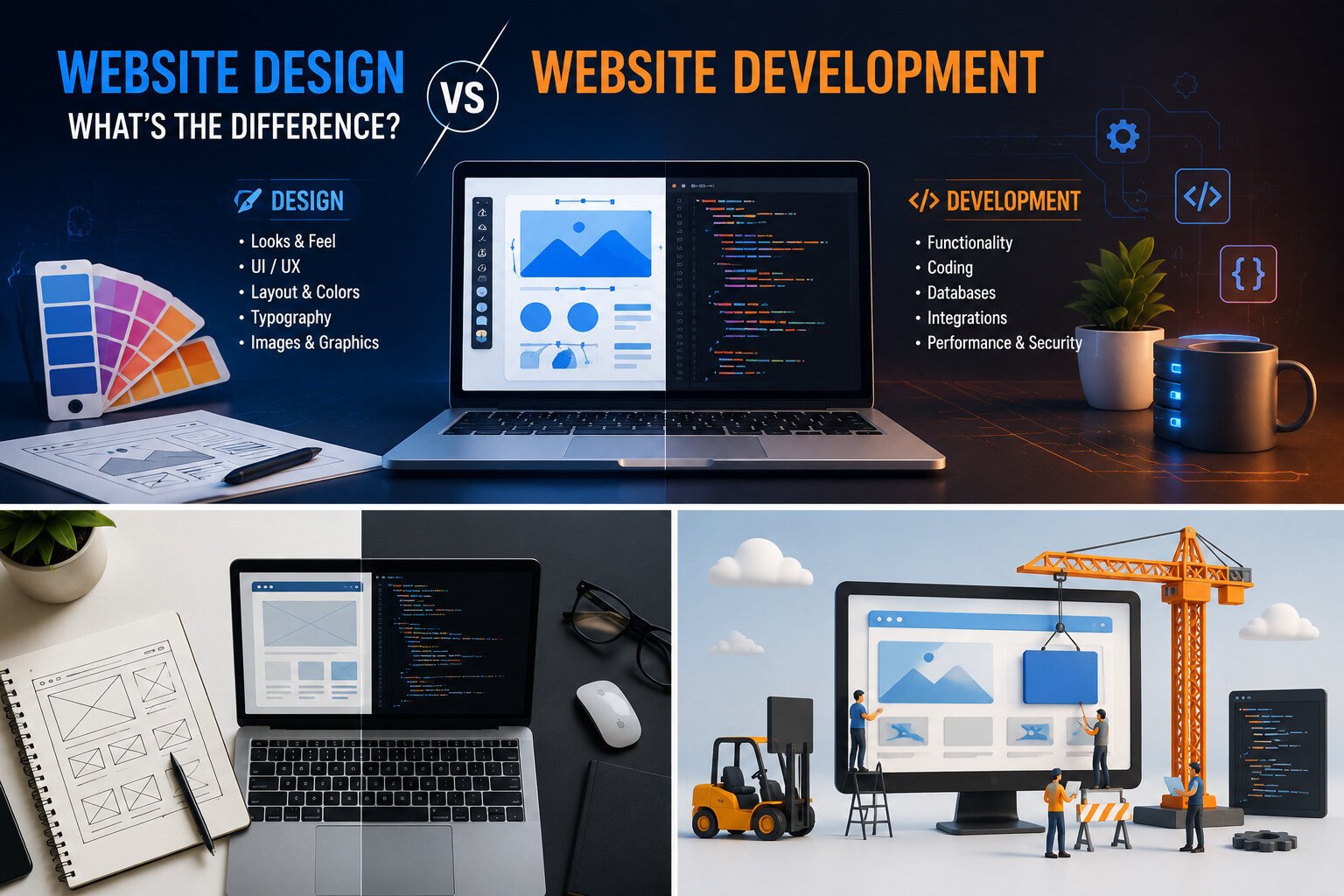
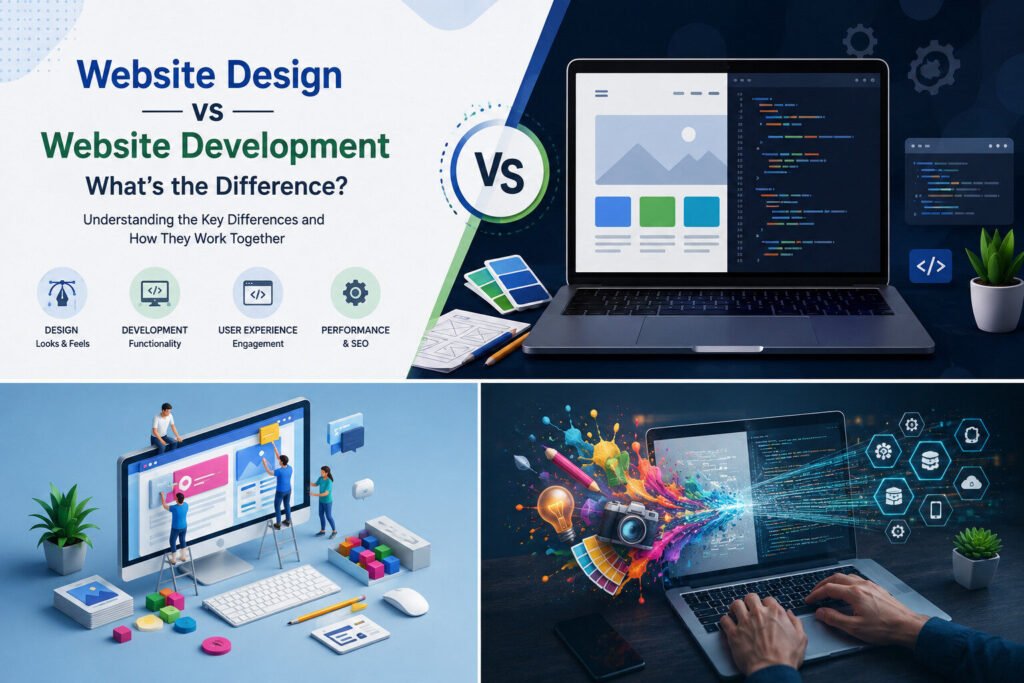
Website design is primarily concerned with how a website looks, feels, communicates information, and guides visitors through the user experience. Website development focuses more on the technical side — the coding, functionality, systems, integrations, databases, and processes that make the website work.
However, the two areas cannot work effectively in isolation.
A beautiful interface with poor functionality can frustrate visitors, while a technically powerful platform with confusing navigation can fail to communicate effectively.
Understanding the difference between Website Design vs Website Development can therefore help you make better decisions when planning a new website, redesigning an existing one, or hiring a professional web team.
What Is Website Design?
Website design is the creative and user-experience side of creating a website.
It determines how visitors see and interact with the platform. This includes the visual appearance, layout, navigation, typography, spacing, images, buttons, content hierarchy, and overall user journey.
A designer considers questions such as:
- Where should important information appear?
- How should the navigation work?
- Which sections should attract attention?
- How can content be presented clearly?
- What should the brand look like online?
- How can visitors find what they need quickly?
- Where should calls to action be placed?
Good design is not simply about making a page look attractive. It is about making the experience understandable and useful.
For example, a restaurant website may need prominent menu information, location details, opening hours, reservation options, and contact buttons. A corporate company may need service pages, company information, projects, leadership details, and enquiry options.
The design should reflect what the visitors actually need.
What Is Website Development?
Website development is the technical process of turning the planned design and requirements into a functioning digital platform.
Developers work with technologies, platforms, code, databases, APIs, integrations, forms, security systems, and other technical components.
Depending on the project, development can involve:
- HTML
- CSS
- JavaScript
- PHP
- Databases
- WordPress
- APIs
- Content management systems
- Ecommerce systems
- Third-party integrations
- Custom web applications
Development is responsible for making different parts of the platform function correctly.
For example, if a visitor submits an enquiry form, development makes sure the form processes the information correctly. If a customer purchases a product, the development system handles the relevant ecommerce functionality.
This is why Website Development Services can range from relatively simple business platforms to highly complex web applications.
Website Design vs Website Development: The Main Difference
The easiest way to understand the difference is to think about a building.
The design is similar to planning how the building should look, how rooms should be arranged, where people should enter, and how they should move through the space.
The development is similar to constructing the building and making sure the electrical systems, plumbing, doors, infrastructure, and other functional components actually work.
In a website:
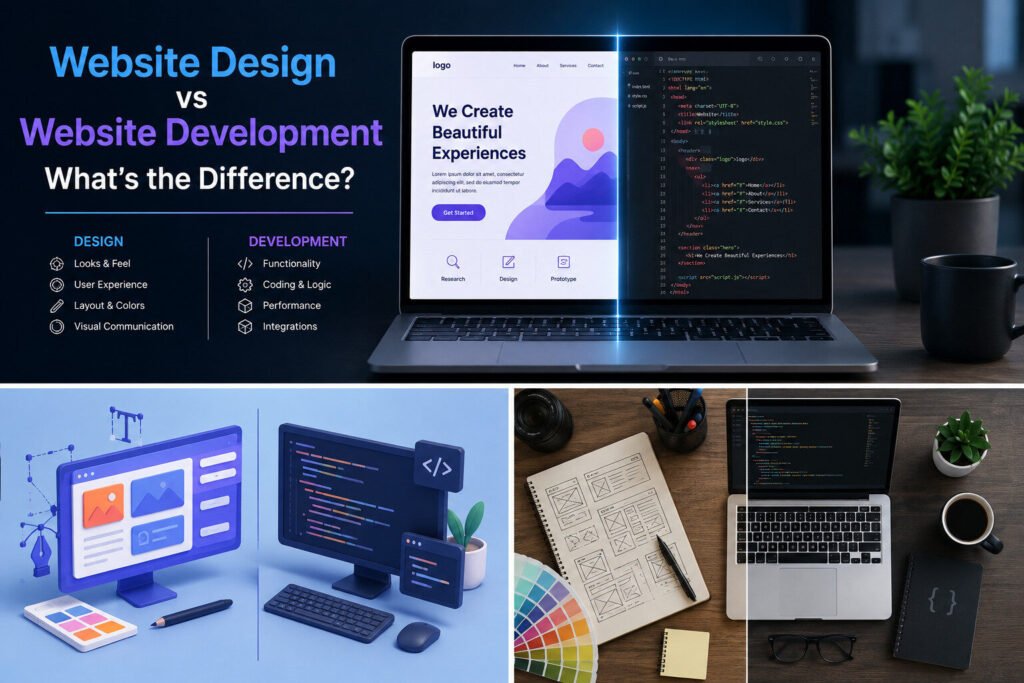
| Website Design | Website Development |
|---|---|
| Focuses on appearance | Focuses on functionality |
| Plans user experience | Implements technical functionality |
| Creates layouts | Builds the working platform |
| Works with typography and visuals | Works with code and systems |
| Plans navigation | Implements navigation |
| Focuses on usability | Focuses on technical performance |
| Creates visual hierarchy | Connects functionality |
| Considers user interaction | Handles technical processes |
In a professional project, both sides need to work together.
What Does a Website Designer Usually Do?
A website designer generally focuses on the visitor-facing experience.
Their responsibilities may include:
Visual Layout
The designer determines how different sections should be positioned and how much visual attention each element should receive.
Typography
Fonts, sizes, spacing, and hierarchy are selected to make information easy to read and consistent with the brand.
Colour & Branding
The interface should reflect the company’s identity while maintaining readability and accessibility.
User Experience
The designer considers how visitors move from one section to another and how easily they can find important information.
Calls to Action
Buttons and enquiry areas are positioned where they make sense within the visitor journey.
Mobile Experience
Layouts need to adapt to smartphones and tablets rather than simply being designed for large screens.
If your primary requirement is a professional visual experience, you may want to explore our Professional Website Design Services.
What Does a Website Developer Usually Do?
A developer takes the requirements and implements the technical side of the platform.
Their responsibilities can include:
Front-End Development
This involves implementing the visible interface so that the design works inside a browser.
Back-End Development
The back end handles processes that visitors may not directly see, such as databases, authentication, business logic, and server-side functionality.
Forms & Integrations
Developers can connect enquiry forms, email systems, payment gateways, CRM tools, APIs, booking systems, and other services.
Database Functionality
Websites that store and retrieve information may require database integration.
Security
Development practices can include authentication, secure configurations, updates, access controls, and other measures appropriate to the platform.
Performance
Developers can optimize technical components to help pages load efficiently and function reliably.
For businesses that require more advanced functionality, our Website Development Services in Hyderabad can be considered as part of the overall digital strategy.
Is Website Design More Important Than Development?
Neither is automatically more important.
The importance depends on the purpose of the website.
A business website may need strong design because credibility and communication are major priorities. At the same time, it still needs reliable development so forms, navigation, mobile layouts, integrations, and other functions work correctly.
An ecommerce platform may require more extensive development because products, shopping carts, payments, customer accounts, and orders must function correctly.
A landing page may place greater emphasis on user experience and conversion-focused design.
The best results usually come when design and development are planned together from the beginning.
When Do You Need Website Design?
Website design becomes particularly important when:
- You are creating a new business identity online
- Your current platform looks outdated
- Visitors struggle to find information
- Your branding has changed
- Your mobile experience is poor
- Your pages are difficult to navigate
- Your conversion rates are weak
- Your content needs better organization
If your business needs a complete visual and user-experience solution, our Website Design Services can provide the foundation for the project.
When Do You Need Website Development?
Development becomes particularly important when your website needs functionality beyond simple information presentation.
Examples include:
- Customer login systems
- Ecommerce functionality
- Payment processing
- Database-driven content
- Booking systems
- API integrations
- Automated processes
- Custom dashboards
- Advanced search
- Business management systems
For businesses with more complex requirements, a development-focused approach may be necessary.
You can also explore our Dynamic Website Development Services if your platform needs database-driven content or interactive functionality.
Static vs Dynamic Websites
Another common area of confusion is the difference between static and dynamic websites.
A static website generally serves predefined pages. This approach can work well for businesses that primarily need to present information such as services, company details, contact information, and portfolios.
A dynamic website can generate or display information based on databases, user actions, content management systems, or other processes.
Neither approach is automatically better.
The right choice depends on your requirements.
If you need a lightweight informational platform, Static Website Design Services may be suitable.
If you require changing content, user interactions, databases, or advanced functionality, a dynamic solution may be more appropriate.
Where Does WordPress Fit In?
WordPress is a content management system rather than simply a design or development service.
It allows businesses to manage website content through an administrative interface while developers and designers can customize the platform according to requirements.
WordPress can be used for:
- Business websites
- Blogs
- Corporate platforms
- Service websites
- Ecommerce stores
- Educational platforms
- Portfolio websites
- Landing pages
If you already have a WordPress website but its design feels outdated, a redesign may be more appropriate than building everything from scratch.
For businesses specifically looking for WordPress Website Design Services in Hyderabad, the project can include design improvements, content organization, theme customization, plugin configuration, responsiveness, and performance considerations.
What About Elementor?
Elementor is a visual page-building tool commonly used with WordPress.
It can make it easier to create and modify page layouts without manually writing every visual component from scratch.
Elementor can be useful for:
- Landing pages
- Service pages
- Business websites
- Custom layouts
- Marketing pages
- Content sections
However, simply using Elementor does not automatically make a website professional.
The quality still depends on design decisions, content structure, responsiveness, performance, accessibility, and implementation.
Businesses interested in this approach can explore Elementor Website Design Services.
How Ecommerce Changes the Requirements
An ecommerce store usually needs both strong design and more extensive development.
The design needs to make product discovery and purchasing simple.
The development needs to support functionality such as:
- Product management
- Categories
- Shopping cart
- Checkout
- Payments
- Customer accounts
- Orders
- Inventory
- Shipping
- Notifications
This is why ecommerce projects should be planned differently from a simple business website.
For businesses selling products online, you can explore E-commerce Website Design Services and WooCommerce Website Development Services depending on the preferred platform and requirements.
Internal links:
Design and Development Both Affect SEO
SEO is sometimes treated as something completely separate from web design and development.
In reality, both can influence the quality of the website experience.
Design can affect:
- Readability
- Navigation
- Content hierarchy
- Mobile usability
- User engagement
Development can affect:
- Page performance
- Crawlability
- Technical structure
- Mobile responsiveness
- Indexability
- Structured implementation
However, SEO is broader than either discipline.
High-quality content, search intent, topical relevance, internal linking, authority, competition, technical health, and other factors also matter.
That is why SEO should be considered during planning instead of being treated as an afterthought.
Why Responsive Design Matters
A website may be viewed on desktops, laptops, tablets, and smartphones.
Responsive design allows the interface to adapt to different screen sizes.
Important considerations include:
- Flexible layouts
- Readable text
- Touch-friendly buttons
- Mobile navigation
- Proper image scaling
- Easy-to-use forms
- Appropriate spacing
A technically functional website can still provide a poor experience if the mobile interface is difficult to use.
For businesses that specifically need a mobile-focused experience, Responsive Website Design Services and Mobile-Friendly Website Design Services can address these requirements.
How Design and Development Work Together
A professional project usually follows a connected process rather than treating design and development as two completely separate jobs.
Step 1: Understand the Business
The team identifies the business model, audience, services, competitors, and goals.
Step 2: Plan the Structure
The sitemap, navigation, content hierarchy, and required functionality are determined.
Step 3: Create the Design
The visual interface and user journey are developed around the planned structure.
Step 4: Develop the Platform
The approved design is implemented with the necessary technical functionality.
Step 5: Test Everything
Pages, forms, navigation, responsiveness, integrations, performance, and other important elements are checked.
Step 6: Launch
After final approval, the platform is published and made available to users.
Step 7: Maintain & Improve
Updates, content changes, technical maintenance, performance improvements, and future functionality can be handled as needed.
Website Design or Website Development: Which One Do You Need?
The answer depends on your current situation.
Choose a Design-Focused Project If:
Your current platform works technically but looks outdated, is difficult to navigate, doesn’t represent your brand well, or provides a poor user experience.
Choose a Development-Focused Project If:
You need new functionality, integrations, databases, ecommerce features, automation, customer accounts, or other technical capabilities.
Choose Both If:
You are building a new platform or completely redesigning an existing one and need both a strong user experience and reliable functionality.
For most businesses starting from scratch, combining design and development from the beginning is usually the most practical approach.
Local Website Design and Development in Hyderabad
Businesses in different parts of Hyderabad may have different audiences and competitive requirements.
For example, a company targeting customers around Mehdipatnam may structure its local content differently from a business serving Banjara Hills or Jubilee Hills.
Similarly, businesses operating around Madhapur, Gachibowli, Hitech City, and Kondapur may need a stronger corporate or technology-focused digital presence depending on their audience.
For businesses in other parts of the city, relevant local pages can also support the overall strategy, including:
These pages should be linked where they are genuinely relevant to the reader rather than adding every location link to every article.
How to Choose the Right Web Design and Development Partner
Whether you need design, development, or both, don’t select a provider only because of a low quotation.
Consider:
Portfolio
Look for projects relevant to your business and requirements.
Technical Capability
Make sure the provider can handle the functionality you need.
SEO Understanding
Ask how SEO-friendly structure and performance are incorporated into the project.
Communication
A clear process makes the project easier to manage.
Ownership
Make sure you understand who controls your domain, hosting, website files, and administrative access.
Support
Ask what happens after launch and how future updates will be handled.
Scalability
Consider whether the platform can grow as your business develops.
Common Mistakes Businesses Make
Choosing Only Based on Price
The cheapest quotation may exclude important services, functionality, content, support, or maintenance.
Focusing Only on Appearance
A beautiful website still needs good navigation, performance, content, functionality, and mobile usability.
Ignoring Content
Design cannot compensate for unclear or incomplete information.
Treating SEO as an Afterthought
Search-friendly structure should be considered during planning and development.
Using Too Many Features
Adding unnecessary animations, plugins, integrations, or functionality can make the platform harder to manage and potentially affect performance.
Not Planning for Growth
A business may outgrow a platform that was never designed with future requirements in mind.
Frequently Asked Questions
1. What is the main difference between website design and website development?
Website design focuses mainly on visual appearance, user experience, layout, navigation, and communication. Development focuses on coding, functionality, databases, integrations, and the technical implementation of the platform.
2. Can one company handle both design and development?
Yes. Many professional web agencies provide both services, which can make communication and project coordination easier.
3. Is website design the same as UI/UX design?
They overlap, but UI focuses more on the interface while UX focuses on the overall experience and how users interact with the platform. Website design often combines elements of both.
4. Do I need development for a simple business website?
Even a simple website requires some level of development to turn the design into a working platform. The complexity of development depends on the website’s requirements.
5. Is WordPress website design or development?
It can involve both. Designing the pages and user interface is the design side, while configuring WordPress, customizing themes, implementing functionality, and integrating plugins involve development work.
6. Which is more important for SEO: design or development?
Both can contribute to a technically sound and user-friendly website, but SEO also depends heavily on content quality, relevance, site structure, authority, search intent, and ongoing optimization.
7. Can I redesign my website without changing the development?
Sometimes. If the existing technical foundation is suitable, a design-focused redesign may be possible. However, outdated technology or poor functionality may make broader development improvements worthwhile.
8. Should I hire a designer or developer first?
For a new project, it is usually better to have design and development planned together. This reduces the risk of creating a design that is difficult or inefficient to implement.
Final Thoughts
Understanding Website Design vs Website Development makes it easier to plan the right digital project for your business.
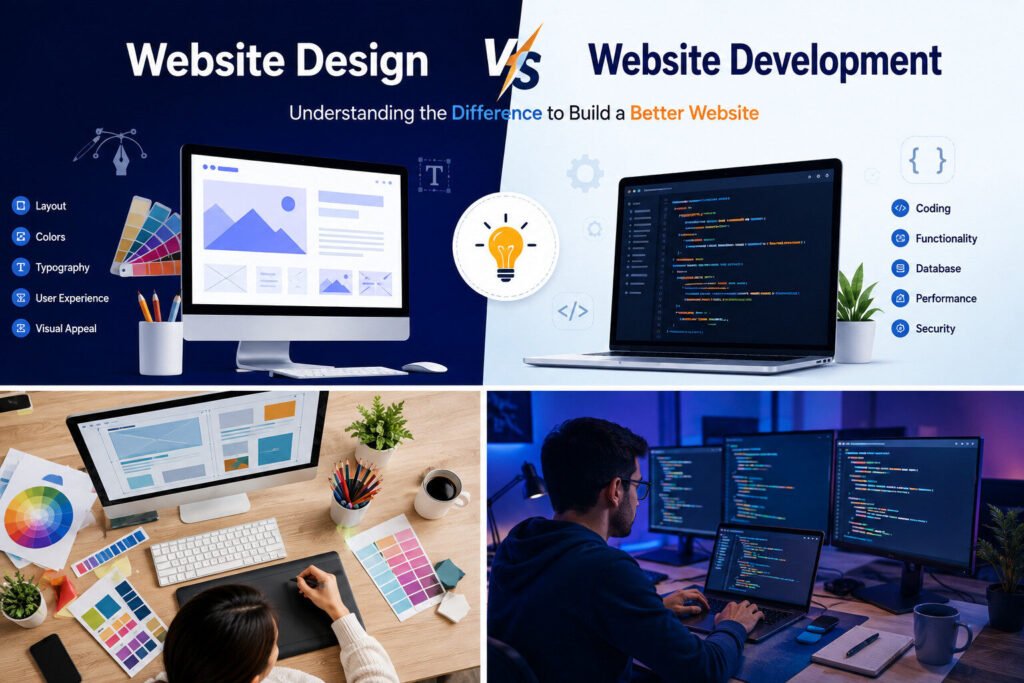
Design determines how visitors experience your brand, while development makes the underlying platform function. One focuses heavily on appearance, communication, usability, and interaction; the other handles technical implementation, functionality, systems, and integrations.
The strongest websites bring these two disciplines together.
If you are building a new business presence, redesigning an outdated platform, launching an online store, or developing a more advanced digital solution, start by identifying your business goals and customer requirements. From there, you can determine the right combination of design, development, content, SEO, and ongoing support.
At IT Reliable Solution, we work on both sides of the process, helping businesses create digital platforms that are visually professional, technically functional, mobile-friendly, search-conscious, and aligned with real business objectives.
Whether your project needs a straightforward business presence, a WordPress solution, an ecommerce platform, a dynamic system, or a complete redesign, the right approach begins with understanding what your business and customers actually need.