
What Makes a Good Business Website? 10 Essential Features
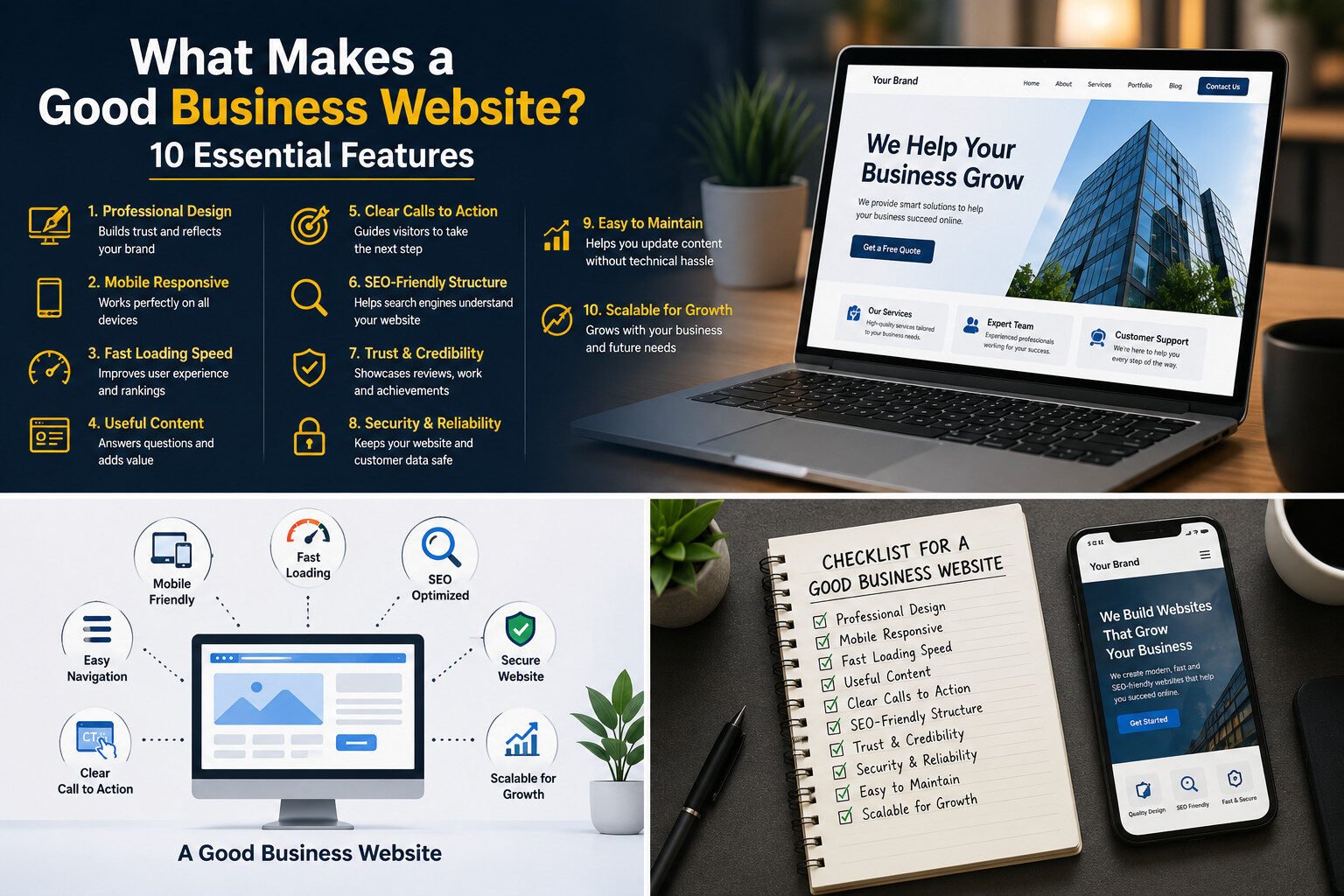
Your business website is often the first place where potential customers learn about your company. Someone may discover your business through Google, social media, an advertisement, a recommendation, or a local search and visit your website before deciding whether to contact you.
That first experience matters.
A visitor should be able to understand what your business does, find the information they need, trust your company, and know what to do next without unnecessary confusion.
But what actually makes a Good Business Website?
It is not simply a matter of choosing attractive colours, adding professional photographs, or installing a modern theme. A successful business platform needs to combine visual presentation with usability, performance, useful content, search visibility, security, and a clear purpose.
A small local business may need a simple service-focused platform, while a growing company may require multiple service pages, lead-generation features, integrations, and a scalable structure.
The right solution therefore depends on the business.
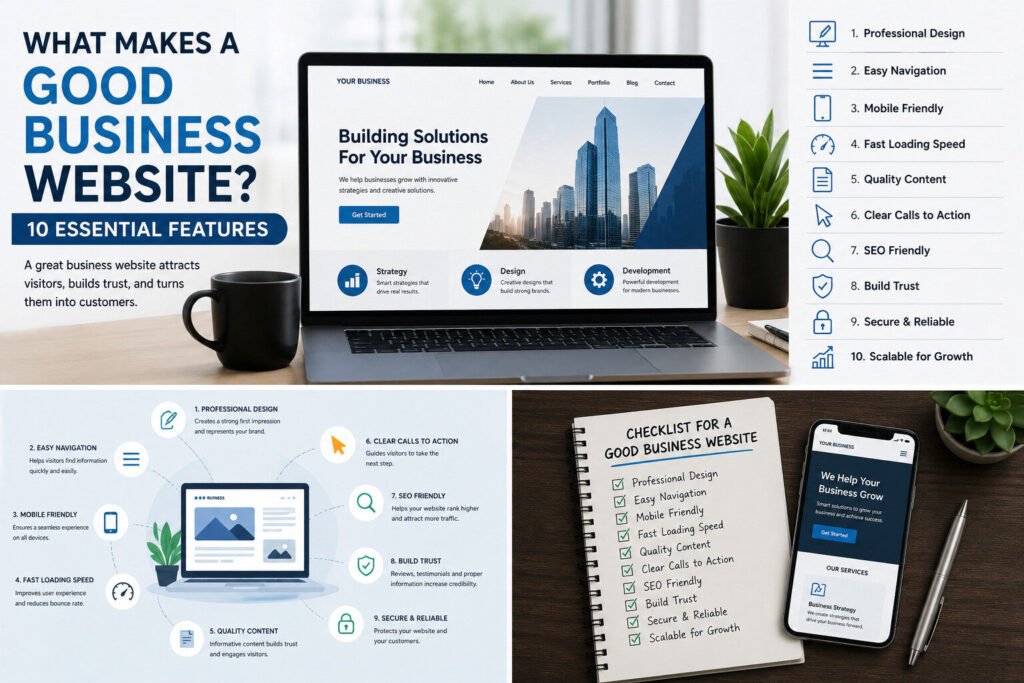
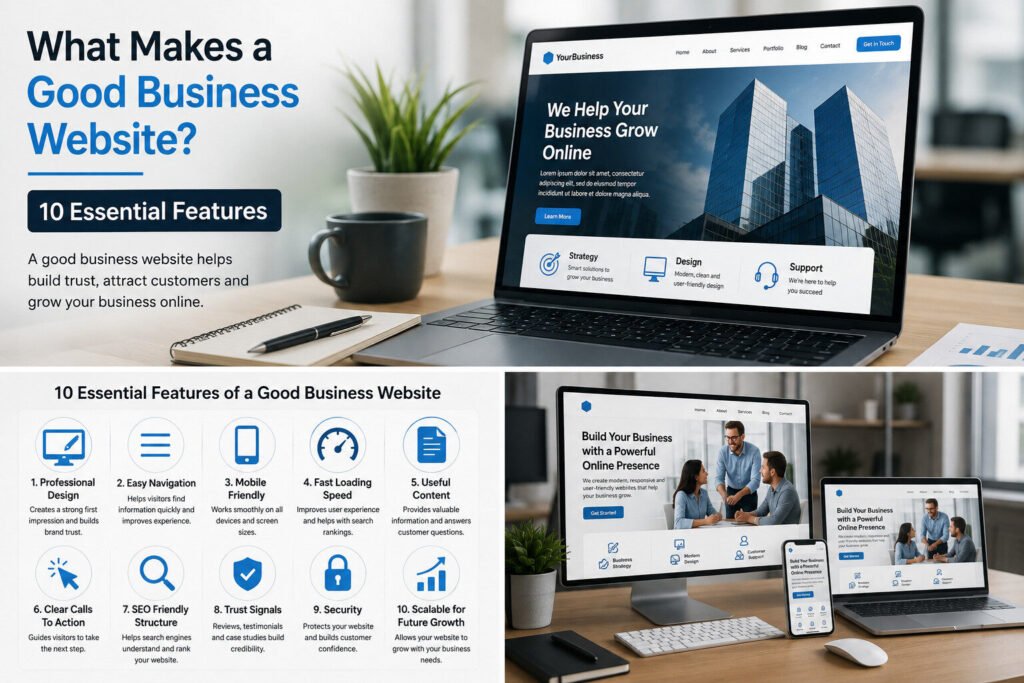
In this guide, we explain 10 essential features of a good business website and why each one matters.
1. Professional Design That Reflects Your Business
The appearance of your website creates an immediate impression of your business.
A professional design should match your brand and make your company appear organized, trustworthy, and relevant to your target audience.
However, professional design does not mean adding as many visual effects as possible.
A strong layout usually focuses on:
- Clear visual hierarchy
- Consistent branding
- Readable typography
- Balanced spacing
- Appropriate images
- Easy navigation
- Well-placed calls to action
- Simple and understandable layouts
For example, a law firm may require a formal and trustworthy visual style, while a creative agency may benefit from a more expressive interface.
The design should therefore be based on your business and your customers, not simply on current design trends.
If your existing platform looks outdated or inconsistent, professional Website Design Services can help create a more effective digital presentation.
2. Simple and Logical Navigation
Imagine a customer visits your website looking for a service but cannot figure out where to find it.
Even if your company provides exactly what they need, poor navigation can cause them to leave.
A Good Business Website should make important information easy to locate.
Depending on the business, the main navigation may include:
- Home
- About Us
- Services
- Products
- Portfolio
- Case Studies
- Blog
- FAQs
- Contact
The structure should not become unnecessarily complicated.
Visitors should be able to understand where they are, where they can go next, and how to return to important sections.
Navigation should also remain consistent across different pages.
A well-planned structure improves the user experience and makes it easier for search engines to understand the relationship between different pages.
3. Excellent Mobile Experience
People use smartphones for almost every type of online search, including finding businesses, comparing services, checking locations, reading reviews, and making enquiries.
Because of this, your website should not be designed only for desktop users.
A mobile-friendly platform should provide:
- Responsive layouts
- Easy-to-use mobile menus
- Readable text
- Properly sized buttons
- Simple forms
- Optimized images
- Comfortable spacing
- Fast loading
- Easy access to contact options
The visitor should not need to zoom in or repeatedly scroll sideways to read information.
A good mobile experience also means considering how people actually interact with a page using their fingers rather than a mouse.
If mobile usability is one of your priorities, Mobile-Friendly Website Design Services can help improve the experience across different screen sizes.
4. Fast Loading Speed
Nobody wants to wait several seconds for a business page to become usable.
Slow performance can make visitors frustrated and may prevent them from exploring other pages.
Several factors can influence loading speed, including:
- Large images
- Unnecessary plugins
- Heavy scripts
- Poor hosting
- Unoptimized code
- Excessive animations
- Poor caching configuration
- Third-party resources
Improving speed should therefore involve looking at the overall technical setup rather than simply compressing a few images.
Important pages such as the homepage, service pages, contact page, and landing pages should receive particular attention.
Businesses with an existing slow platform can consider Website Speed Optimization Services to identify performance problems and improve the technical experience.
5. Useful, Original, and Customer-Focused Content
A website should answer the questions customers actually have.
Visitors may want to know:
- What services do you provide?
- Who are your services for?
- What areas do you serve?
- How does your process work?
- Why should they choose you?
- What experience do you have?
- How can they contact you?
- What should they expect?
Good content explains these points clearly without unnecessary repetition.
Instead of writing content only to include keywords, businesses should focus on providing useful information that helps visitors make decisions.
For example, a service page can explain what the service includes, who it is suitable for, how the process works, important considerations, and how customers can get started.
This approach creates a more useful experience for people and provides stronger foundations for organic search visibility.
6. Clear Calls to Action
A website should not leave visitors wondering what they are supposed to do next.
Depending on your business, the desired action may be:
- Call your business
- Request a quote
- Book an appointment
- Submit an enquiry
- Send a WhatsApp message
- Buy a product
- Register for a service
- Schedule a consultation
These actions can be encouraged through clear calls to action.
Examples include:
Get a Free Quote
Book an Appointment
Talk to Our Team
Request More Information
Start Your Project
Shop Now
The CTA should make sense in the context of the page.
For example, a service page may use “Request a Quote,” while an ecommerce product page may use “Add to Cart.”
If your primary goal is generating enquiries, Lead Generation Website Design Services and Conversion-Focused Website Design Services can be considered when planning the structure.
7. SEO-Friendly Website Structure
A business website should be created so that both visitors and search engines can understand its content.
SEO-friendly structure includes more than adding keywords to pages.
Important elements can include:
- Logical page hierarchy
- Descriptive URLs
- Proper heading structure
- Relevant title tags
- Useful meta descriptions
- Internal linking
- Optimized images
- Mobile responsiveness
- Crawlable content
- Good page performance
Internal linking is particularly useful when you have multiple related services.
For example, a business offering website design, development, ecommerce, WordPress, and maintenance services can connect these relevant pages so visitors and search engines can discover related information.
SEO should support the user experience rather than make the content difficult to read.
8. Trust-Building Information
Before contacting a company, customers often want evidence that the business is genuine, experienced, and capable of delivering what it promises.
A strong business platform can include appropriate trust-building information such as:
- Company background
- Team information
- Experience
- Certifications
- Portfolio
- Case studies
- Client testimonials
- Reviews
- Awards
- Industry memberships
- Frequently asked questions
However, trust signals should be genuine.
Avoid making exaggerated claims that cannot be supported.
Instead, demonstrate experience through actual projects, useful information, clear business details, transparent processes, and accurate claims.
This helps create a more credible experience for potential customers.
9. Security and Reliable Functionality
Security is important for every business platform, particularly when visitors submit personal information, create accounts, make payments, or interact with third-party systems.
Depending on the website, security considerations may include:
- HTTPS
- Secure login systems
- Strong access controls
- Software updates
- Plugin and theme updates
- Regular backups
- Secure forms
- Monitoring
- Reliable hosting
Functionality should also be tested regularly.
Important features such as contact forms, enquiry buttons, menus, payment systems, booking forms, and integrations should work as expected.
A website can look excellent but still fail from a customer’s perspective if an important enquiry form does not work.
10. Scalable Structure for Future Growth
Your business may change significantly over time.
You may introduce:
- New services
- New products
- Additional locations
- New team members
- Online bookings
- Ecommerce
- Customer portals
- Educational resources
- New marketing campaigns
- Additional landing pages
A website should therefore be planned with reasonable future growth in mind.
A scalable structure allows you to add relevant pages and functionality without completely rebuilding the platform every time your business expands.
For businesses with specific requirements, Custom Website Design Services can provide greater flexibility than relying entirely on a generic template.
Bonus Feature: Convenient Contact Options
A business website should make communication easy.
Depending on your audience, you may want to provide:
Phone
Useful when customers prefer speaking directly with someone.
Suitable for detailed enquiries and professional communication.
Helpful for quick questions and direct conversations.
Contact Forms
Useful when you need specific information from potential customers.
Appointment Booking
Useful for consultants, clinics, salons, educational institutions, and other appointment-based businesses.
Location Information
Important for businesses with physical offices, stores, clinics, or service locations.
The best approach is to provide the options that your customers are actually comfortable using.
What Makes a Business Website Different From a Personal Website?
A business platform generally has a specific commercial purpose.
It may need to:
- Explain services
- Generate leads
- Build credibility
- Sell products
- Attract local customers
- Support marketing campaigns
- Answer customer questions
- Encourage enquiries
A personal website may have a different purpose, such as showcasing an individual’s portfolio, interests, or professional experience.
Because business platforms often influence purchasing decisions, they need to be designed around both customer needs and business objectives.
Do Small Businesses Need a Large Website?
Not necessarily.
The number of pages should depend on how much useful information your customers need.
A small business may only require:
- Home
- About
- Services
- Portfolio
- FAQs
- Contact
A larger company may need individual pages for every service, industry, location, product, case study, and resource.
The objective should not be to create as many pages as possible.
Instead, each page should have a clear purpose and provide something useful to visitors.
For businesses with a very focused offering, One Page Website Design Services can also be an appropriate solution.
When Should You Redesign Your Business Website?
Sometimes the problem is not the business itself but the digital platform representing it.
Consider a redesign if:
- Your website looks outdated
- It is difficult to use on mobile
- Navigation is confusing
- Important services are difficult to find
- Pages load slowly
- Your branding has changed
- Your content is outdated
- Contact options are difficult to locate
- The platform is difficult to manage
- Your website no longer reflects your business
A redesign can focus on improving the existing platform instead of automatically rebuilding everything.
Businesses using WordPress can explore WordPress Website Redesign Services when their existing platform needs visual, structural, or usability improvements.
How Ecommerce Businesses Need a Different Approach
A company selling products online has additional requirements compared with a service-based business.
An ecommerce platform may require:
- Product categories
- Product detail pages
- Search
- Filters
- Shopping cart
- Checkout
- Payment integration
- Customer accounts
- Order management
- Shipping information
- Product reviews
In this situation, design and functionality need to work closely together.
The customer should be able to discover a product, understand its details, add it to the cart, complete checkout, and receive appropriate information throughout the process.
Businesses planning to sell online can explore E-commerce Website Design Services or WooCommerce Website Development Services based on their requirements.
How a Good Business Web Supports SEO
A strong website and a strong SEO strategy should complement each other.
A useful platform can support SEO through:
- Clear information architecture
- Helpful service pages
- Relevant internal links
- Search-friendly URLs
- Strong headings
- Useful content
- Mobile usability
- Good performance
- Proper image optimization
- Crawlable content
But SEO does not end with website development.
Organic visibility also depends on factors such as content quality, relevance, competition, authority, search intent, technical health, and ongoing optimization.
Therefore, don’t judge a website only by whether it is described as “SEO-friendly.”
Ask what actual SEO foundations are being implemented.
How to Check Whether Your Website Is Good
You can perform a simple review yourself.
Open your website and ask:
Can I understand the business quickly?
A visitor should not have to read the entire homepage to understand what the company does.
Can I find the services easily?
Important services should be accessible without unnecessary clicks.
Does it work properly on mobile?
Check menus, text, forms, buttons, images, and spacing.
Can I contact the business easily?
Make sure phone, email, WhatsApp, forms, or booking options are easy to find.
Is the information current?
Check contact details, services, team information, business hours, and other important information.
Does the content answer customer questions?
Useful information can reduce uncertainty and help visitors make decisions.
Does the platform feel trustworthy?
Look for genuine company details, testimonials, projects, credentials, and other relevant evidence.
Are the pages reasonably fast?
Check important pages rather than judging performance from only the homepage.
Common Business Website Mistakes to Avoid
1. Too Much Visual Clutter
Adding too many animations, colours, popups, and effects can make information harder to consume.
2. Weak Homepage Messaging
Visitors should quickly understand what you offer and who you serve.
3. Poor Mobile Experience
A desktop-only approach can create problems for smartphone users.
4. Keyword Stuffing
Repeating the same keyword excessively can make content unnatural.
5. Generic Content
Content that says very little about your actual business does not help customers make decisions.
6. Missing Trust Information
Visitors may hesitate if they cannot find enough information about the company.
7. Difficult Contact Process
Don’t make customers search through several pages just to find a phone number or enquiry form.
8. Outdated Information
Old services, incorrect contact details, or expired information can damage credibility.
9. Unnecessary Features
Every feature should serve a clear purpose.
10. Ignoring Maintenance
Websites need updates, security checks, content improvements, and technical attention over time.
10 Essential Features Checklist
Before launching a new platform or redesigning an existing one, check whether you have:
- Professional and consistent design
- Simple navigation
- Responsive mobile experience
- Good loading performance
- Useful and original content
- Clear calls to action
- SEO-friendly structure
- Genuine trust signals
- Security and reliable functionality
- A scalable structure
These features work together rather than independently.
A visually attractive platform with poor content may not communicate effectively.
Likewise, a technically advanced platform with confusing navigation may not provide a good customer experience.
The objective is balance.
Frequently Asked Questions
1. What makes a good business web?
A good business website should be professional, easy to navigate, mobile-friendly, fast, secure, informative, search-friendly, and built around clear customer and business objectives.
2. How many pages should a business website have?
There is no fixed number. The ideal structure depends on the business, services, products, audience, locations, and amount of information customers need.
3. Is mobile responsiveness important for a business website?
Yes. Customers can access websites from smartphones, tablets, laptops, and desktops, so the platform should provide a comfortable experience across different screen sizes.
4. Does website speed affect the user experience?
Yes. Slow pages can make visitors frustrated and may prevent them from exploring your services or completing important actions.
5. Does a professional design guarantee Google rankings?
No. Design is only one part of a broader SEO strategy. Search visibility also depends on content, relevance, technical quality, authority, competition, search intent, and other factors.
6. Should every business have a blog?
Not necessarily. A blog can be valuable when a business has genuinely useful topics to explain and questions to answer. Content should be created for a clear audience and purpose rather than simply increasing the number of pages.
7. Is WordPress good for business websites?
WordPress can be suitable for many businesses because it offers flexible content management and supports different types of functionality. The right platform depends on the individual project’s requirements.
8. Should I redesign my existing website or create a new one?
It depends on the condition of the current platform. If the technical foundation is suitable, redesigning may be enough. If the platform has outdated technology, poor functionality, security issues, or structural limitations, a broader redevelopment may be more suitable.
Final Thoughts
A Good Business Website is not simply a collection of attractive pages.
It should help visitors understand your business, find information easily, trust your company, and take the next appropriate step.
Professional design, clear navigation, mobile responsiveness, speed, useful content, strong calls to action, SEO-friendly structure, trust signals, security, and scalability all contribute to that experience.
Most importantly, the platform should be created around real customer needs rather than simply following design trends or adding unnecessary features.
If your existing website is difficult to use, outdated, slow, poorly structured, or no longer represents your business, it may be time to improve it.
At IT Reliable Solution, we help businesses create digital platforms based on their individual goals, audience, services, and future requirements. Whether you need a new business platform, redesign, WordPress solution, ecommerce store, landing page, or custom development, the right approach starts with understanding what your customers actually need.
A website should not simply exist online. It should actively support your business, communicate your value, and make it easier for customers to take action.